Do I need an answer that changes less, or an answer that shares fewer of my errors? The answer helps decide what scores a learning target. The Breaking Bellman combinations table measured these choices. Here are the recipes I use, with a number to illustrate each one.
Two dials
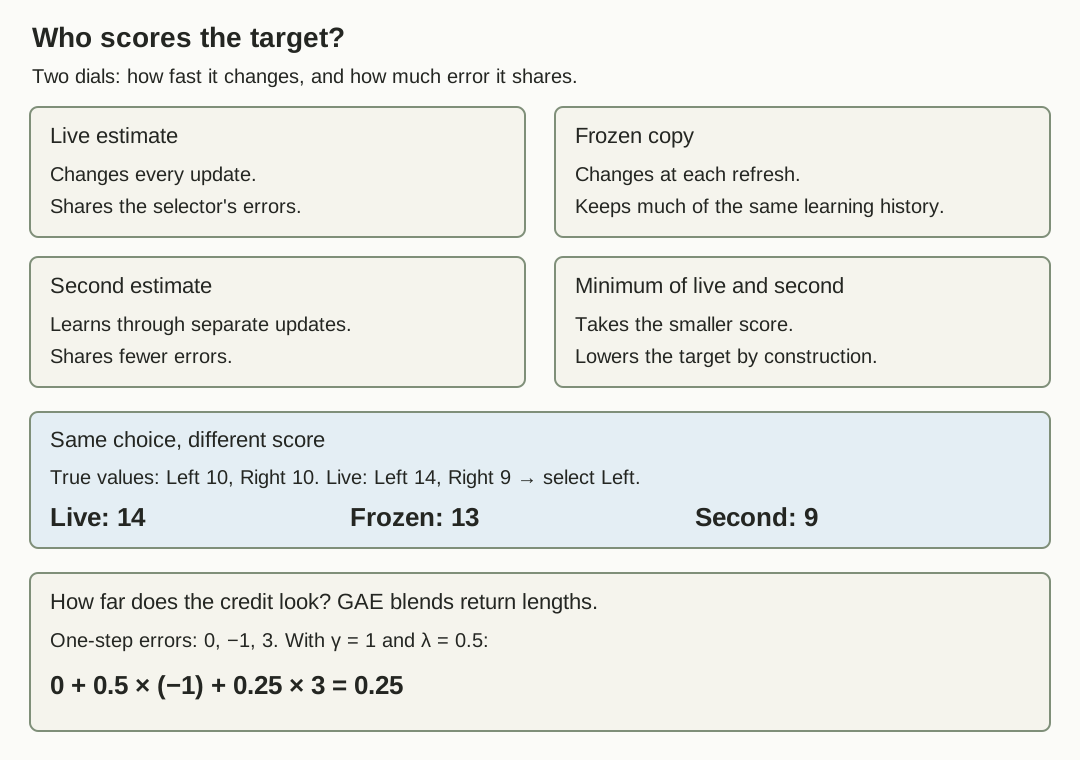
A target is the reference value an update moves toward. There are two dials for the estimate that scores it: how fast it changes, and how much it shares the selector's errors. Here is where the game's four scorers sit:
scored by |
Changes | Shares the selector's errors |
|---|---|---|
The live estimate |
every update | all of them |
A frozen copy |
only at each refresh | often much (same learning history) |
Scored by a second estimate |
when it learns | fewer (separate updates) |
The smaller of live and second |
when either learns | fewer, and lowered by construction |
A frozen copy addresses change over time, while a second estimate addresses shared errors. Neither guarantees accuracy.
The recipes
Freeze when the target changes too fast
A frozen copy changes only when it is refreshed. If the live guess rises from 10 to 14, the stored copy still scores 10 until the next refresh.
Take a second estimate when over-estimates win
If the learner keeps trusting actions because of over-estimates, a frozen copy preserves the error it froze. A second estimate can escape that error. In this example, the true values are 10 and 10.
| Estimate | Left | Right |
|---|---|---|
The live estimate |
14 | 9 |
A frozen copy |
13 | 8 |
Scored by a second estimate |
9 | 11 |
The live estimate selects Left because it over-estimates its value. The frozen copy still scores that choice too high, at 13, while the second estimate scores it at 9.
The minimum lowers the target
Taking the smaller of live and second gives the lower number, so live 14 and second 9 produce a target of 9. This helps when over-estimates drive bad choices and hurts when estimates are already accurate.
Blend the return lengths instead of picking one
These recipes choose who scores the target, but there is also a choice about how far its return looks. A one-step target uses the value estimate just after the move, while a full-return target waits for every reward in the episode. That is the tradeoff between short and long returns: a short return leans on a guess that can be biased, and a long return carries every reward and the noise with it.
Generalized advantage estimation (GAE) handles that choice by mixing the errors from many return lengths to estimate how much credit one action earned. Each error is reward + gamma V(next) - V(now), the gap a reward opens in the value estimate. GAE adds them as delta + gamma lambda delta_next + ..., so each later error carries one more factor of gamma lambda. This estimates action credit. PPO's clip has a different job: it limits the incentive to change the policy, without imposing a hard step bound.
Suppose three moves pay 0, 0, 4, and the frozen values are 2, 2, 1, 0. The errors are 0, -1, 3, so at lambda 0.5 the first move earns 0 - 0.5 + 0.75 = 0.25. Lambda controls the decay: 0.95 does not mean 95 percent full return and 5 percent one step. At lambda = 0, this is the one-step estimate. At lambda = 1, it is the full return minus the starting value, provided the episode really ends.
The table is one reading, not a law
Taking a minimum lowers the target. That mechanism is general, but the evidence here is thin. When scored by a frozen copy, the frozen chooser made 159.1 ± 5.2, compared with 147.5 ± 22.0 for the live chooser. Three seeds do not establish a winner. These results cover one environment, one settings row, and one seed set. Elsewhere, the best cell could be in the bottom row or the last column.
A stable target can still be wrong, and a less biased target can still produce unstable learning. Each recipe chooses which error to accept.
GAE: the formula, the boundaries, and the source
GAE sums the one-step errors as a geometric series. With delta_t = r_t + gamma V(s_{t+1}) - V(s_t), the credit for the action at step t is A_t = delta_t + gamma lambda delta_{t+1} + (gamma lambda)^2 delta_{t+2} + .... Each later error fades by one more factor of gamma lambda. That is why lambda is a decay rate and not a share between two recipes. A weight of 0.95 does not mean 95 percent of the full return and 5 percent of the one-step estimate. It means the next error keeps 0.95 of the weight, the one after keeps 0.95 squared, and so on.
The two ends are exact. At lambda = 0, only delta_t is left, so GAE is the one-step estimate r_t + gamma V(s_{t+1}) - V(s_t). At lambda = 1, the errors telescope to the discounted return minus the starting value V(s_t), for an episode that reaches a real end. If the rollout is cut off before the end instead, the last value V(s_H) stays in as a bootstrap at the boundary, and the trace does not cross a reset.
GAE estimates how much better an action did than the state's baseline value. That is action credit. Proximal Policy Optimization (PPO) clip does a separate job. It limits the incentive to change the policy too far, and it is not a hard bound on the step. The two travel together because PPO uses GAE, but they answer different questions. The identity and the endpoints follow Schulman et al., Section 3, equations 16 to 18.
Where the numbers come from
The Left and Right estimates are invented; the true values are 10 and 10. The second estimate also over-values Right, at 11, but that error never enters this target because the live selector did not pick Right. This is the Double Q-learning split: selection and evaluation use different estimates, and their errors can remain correlated.
The published methods behind the recipes
A frozen scorer is the DQN target network. Double DQN selects with the live network and evaluates with a frozen copy, so the two still share a learning history. The minimum is the clipped estimate of TD3. In the combinations table, the ± is standard error across three CartPole seeds, not target movement.